The Cheapest Feature Wins: What Wave Taught Ivorian Banking About Information Systems Architecture

Source: author’s own.
Why read this post?
In this article, we examine how a zero-fee fintech disrupter defeated established telecommunications giants in Côte d’Ivoire by redesigning core information system architecture rather than chasing product features. By reading this analysis, you will learn how Information Systems (IS) shape underlying cost structures, why digital transformation alters value creation paths rather than software tooling, and the strict physical limits of digital solutions in driving broader economic impact.
A Market That Skipped the Branch
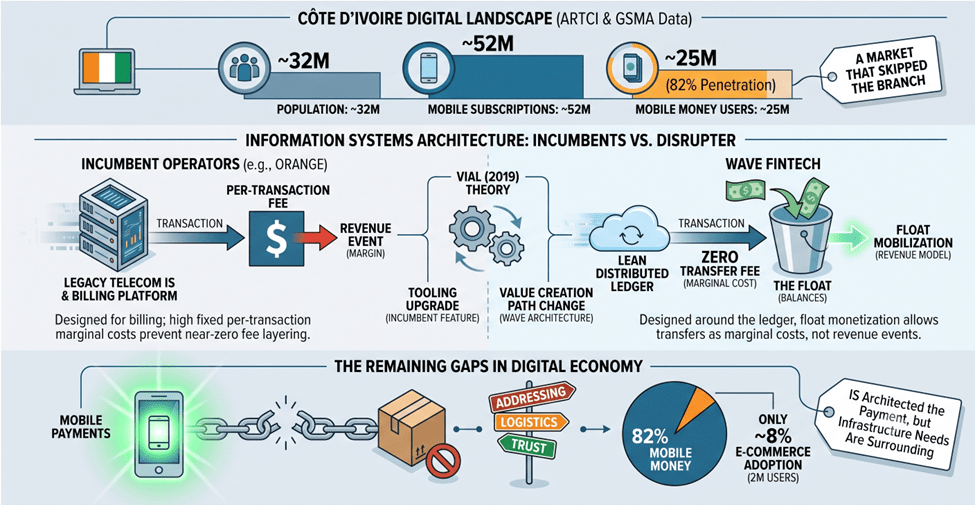
Most literature on African information systems highlights project failures—imported enterprise platforms unable to adapt to local economic realities. Côte d’Ivoire offers a compelling counter-narrative: a market that bypassed traditional branch banking entirely. Regulatory data from the Autorité de Régulation des Télécommunications/TIC de Côte d’Ivoire (ARTCI, 2025) reveals a booming landscape with 52 million mobile subscriptions for a population of 32 million, 28 million mobile internet subscriptions, and an 82% mobile money penetration rate comprising 25 million active users. Across Africa, mobile money transaction values surpassed $1 trillion in 2024, a 15% year-on-year increase (GSMA, 2025). For years, telecom operators dominated this ecosystem, with Orange maintaining a leading share of roughly 59% of mobile money accounts and 52% of mobile subscribers (ARTCI, 2025).
Architecture Over Features: Legacy Billing Systems vs. Lean Ledgers
The market dynamic shifted dramatically with the entry of Wave—a fintech operating without network infrastructure, spectrum licenses, or legacy billing software. Wave did not win by offering superior features; its mobile application was significantly simpler than Orange Money’s feature-rich portal. Instead, Wave attacked the foundational variable protecting incumbent profitability: transaction fees.
While zero-fee transfers appear to be an aggressive pricing strategy, they actually represent a fundamental information systems architecture decision. Incumbent operator systems evolved from telecommunications billing platforms where transactions are individual units of account and revenue is recognized per event. Implementing near-zero fees on legacy architecture is financially prohibitive because the underlying cost model demands per-transaction margins. Conversely, Wave architected its distributed ledger around float monetization and a lean agent network, treating individual transfers as marginal operational costs rather than primary revenue events. Wave publishes the resulting pricing: sending costs 1%, while deposits, withdrawals and bill payments are free (Wave Mobile Money, 2026). Core system design, not the feature set, dictates what a company can afford to charge.
Source: author’s own.
Theoretical Alignment: Value Creation Paths in Digital Transformation
This real-world case directly illustrates Vial’s (2019) conceptualization of digital transformation. Vial defines digital transformation as an organizational process that structurally alters value creation paths through digital technologies, rather than merely upgrading software tools. While incumbent firms can rapidly copy front-end software features during agile development sprints, they cannot easily replicate an agile cost structure. The cost model is deeply embedded within legacy information systems built over a decade, upon which corporate financial reporting and governance depend.
The Uncomfortable Truth and Systemic Limits
However, a critical analysis reveals the physical boundaries of digital transformation. Despite high mobile money penetration, ARTCI (2025) data indicates that only 2 million citizens—approximately 8% of the population—engage in e-commerce. As Bonina et al. (2021) observe in their framework for digital platforms in developing economies, platform architecture alone cannot guarantee broader economic value capture if the wider socio-technical ecosystem remains underdeveloped. Information systems can streamline transaction ledgers, but they cannot resolve physical infrastructure deficits such as unstructured street addressing, fragmented logistics, weak consumer protection, or low institutional trust.
Conclusion & Executive Takeaway
Evaluating an information system requires examining its underlying cost assumptions rather than its surface software capabilities. True digital transformation succeeds when system architecture aligns with local unit economics, though sustainable digital economies still depend on physical infrastructure beyond the ledger.
References
- ARTCI. (2025). Rapport sur les statistiques du marché des télécommunications en Côte d’Ivoire. Autorité de Régulation des Télécommunications/TIC de Côte d’Ivoire. https://www.artci.ci
- Wave Mobile Money. (2026). Wave – Mobile Money [Mobile application]. Apple App Store. https://apps.apple.com/
- Bonina, C., Koskinen, K., Eaton, B., & Gawer, A. (2021). Digital platforms for development: Foundations and research agenda. Information Systems Journal, 31(6), 869–902. https://doi.org/10.1111/isj.12326
- GSMA. (2025). State of the industry report on mobile money 2025. GSM Association. https://www.gsma.com/mobilemoney
- Vial, G. (2019). Understanding digital transformation: A review and a research agenda. The Journal of Strategic Information Systems, 28(2), 118–144. https://doi.org/10.1111/isj.12326
 bramssamap-ldpfx
Leave a comment